I actively research real-world authorization flaws and privacy boundary weaknesses in large-scale platforms. While testing Instagram’s group chat permission model, I discovered an interesting edge case involving block relationships and group membership logic.
The Privacy Expectation
Instagram clearly communicates in its settings:
“You can be added to group chats by everyone, except by people you’ve blocked.”
From a user’s perspective, this is straightforward.
Blocking someone should terminate all interaction channels — including being added to group chats.
The interface reflects this correctly.
But I wanted to understand whether the enforcement also held strong at the backend level.
High-Level Technical Walkthrough
To evaluate this, I conducted a controlled test between two accounts:
- User A — The account enforcing the block
- User B — The account later blocked
1️⃣ Initial Interaction
User B created a group chat and added User A.
While this legitimate action occurred, the membership request was observed through a proxy tool to understand how the backend processes group-add operations.
At this stage, everything behaved normally.
2️⃣ Relationship Change
Next:
- User A blocked User B
- User A exited the group
The UI now prevented User B from re-adding User A.
As expected.
From a privacy standpoint, the boundary appeared enforced.
3️⃣ Replaying a Previously Valid Action with Some Race Action
Instead of attempting the action via the interface, the previously observed membership request was resent via a certain Race condition.
No UI interaction.
No visible permission flow.
Just re-triggering the earlier group-add operation.
Result
User A was added back into the group conversation — despite the active block relationship.
This demonstrated that while the UI respected the block rule, the backend did not appear to re-evaluate the relationship state during execution of that membership action.
Security Insight
This behavior suggests a gap in dynamic authorization validation.
In systems where permissions depend on real-time user relationships (like blocking), access decisions must be checked at execution time — not only when an action was first initiated.
If relationship state changes (like a block), previously valid actions should no longer succeed.
Why This Matters
Blocking is often used in situations involving:
- Harassment prevention
- Personal boundaries
- Safety enforcement
- Abuse mitigation
If a blocked user can indirectly reintroduce contact via group mechanics, it weakens the trust model of the platform.
While exploitation requires certain conditions, the privacy expectation remains clear:
A blocked user should not be able to re-establish interaction channels.
Suggested Mitigation
To strengthen enforcement:
- Perform real-time block relationship validation before processing group membership updates
- Reject group-add actions when a block relationship exists in either direction
- Ensure membership mutations are context-aware of updated relationship states
Severity Justification
- No account takeover
- No data exposure
- No privilege escalation beyond intended functionality
However:
- Privacy guarantees are weakened
- Blocking trust boundary is impacted
- Harassment vectors could be amplified
Final Thoughts
Large-scale platforms like Instagram rely heavily on relationship-based authorization logic.
Even subtle inconsistencies between UI enforcement and backend validation can create unexpected privacy gaps.
Responsible disclosure helps strengthen those boundaries — and reinforce user trust at scale.
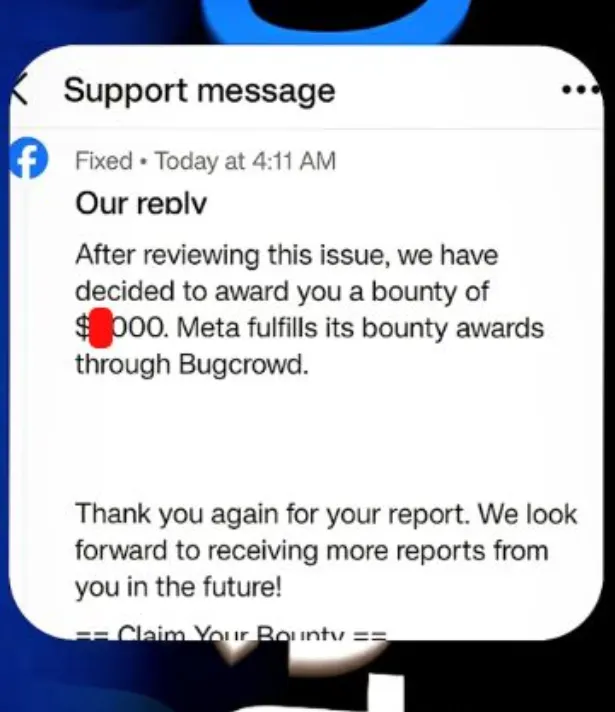
Meta Hall of Fame 2025
Recognised security researchers are listed here:https://bugbounty.meta.com/leaderboard/?league=&year=2025
🔚 Conclusion
This research highlights how even well-defined privacy controls on platforms like Instagram must be consistently enforced at every layer — especially at the backend.
While the interface correctly reflected the expected behavior, deeper testing showed that dynamic relationship-based permissions require strict real-time validation.
Strengthening these controls helps reinforce user trust and ensures that blocking truly functions as a definitive boundary — exactly as users expect it to on platforms owned by Meta Platforms, Inc..